The Goddess Returns
A journey through Durga Puja. Enable JavaScript for the interactive experience, or read the story here.
Mahalaya — The invocation
Before sunrise, Bengal listens and watches. Mahishasura Mardini tells of Ma’s victory over Mahishasura—her strength a shelter, her coming a promise of hope.
Mahalaya holds remembrance and anticipation together: families offer tarpan for their ancestors, and turn toward the coming of the Divine Mother.
For generations, the early-morning Mahishasuramardini broadcast, with Birendra Krishna Bhadra’s recitation, has helped give this dawn its familiar voice. Bengali television presentations also bring the story to life through performance.
Here, an original moving tableau evokes that beloved morning: Ma Durga, serene in her protective power, her lion beside her, overcoming Mahishasura. It is an artistic tribute to the story, rather than a recording of a particular programme.
Shashti — Uma comes home
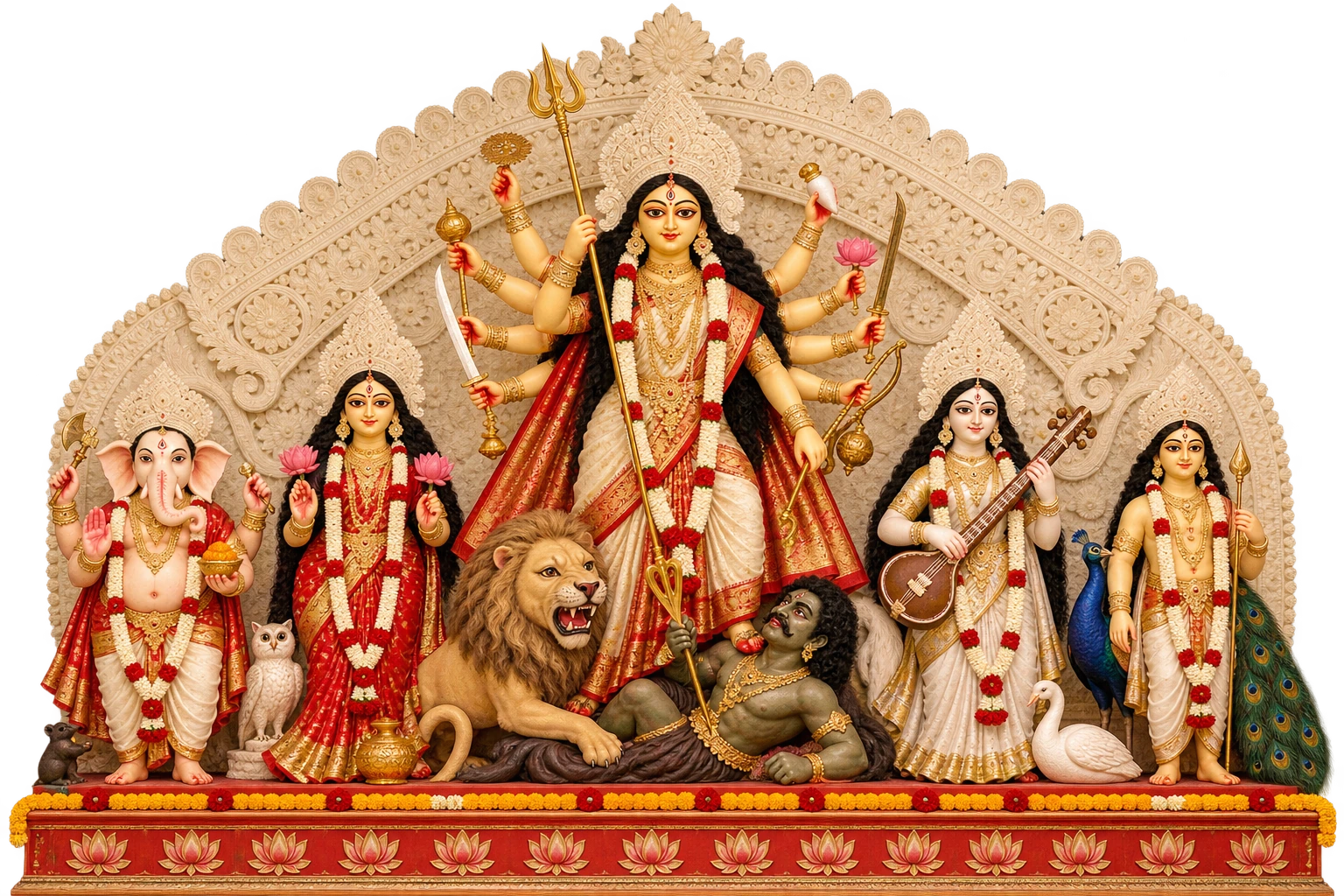
We welcome the Divine Mother as our own Uma, returning to her parents’ home with Lakshmi, Saraswati, Ganesha, and Kartik. The pandal becomes a home prepared with love.
The mother of the world is also Bengal’s cherished daughter. This closeness is at the heart of Agomoni: the joy of welcoming Uma back to her parents’ home, with her four children beside her.
Shashti brings Bodhan, the ceremonial awakening, along with invitation and preparation for worship. Evening lamps illuminate the family pratima as the days of puja approach.
Lakshmi’s lotus, Saraswati’s veena, Ganesha’s elephant face, and Kartik’s peacock make the family recognizable. In this homecoming, divine grandeur and the affection of an ordinary household meet.
Saptami — The living earth
At first light, the Nabapatrika is bathed and carried home. Nine plants, wrapped in a red-bordered white sari, bring Bengal’s living earth into the puja.
Nabapatrika means nine plants: banana, colocasia, turmeric, jayanti, bilva, pomegranate, ashoka, arum, and paddy are gathered into a sacred bundle.
On Saptami morning, the bundle is bathed, dressed in a red-bordered white sari, and placed beside Ganesha. Affectionately called Kola Bou, it is a form of sacred plant worship—not simply the story of Ganesha’s wife.
The main days of puja begin. Our scene follows the passage from riverbank to altar: green leaves, water, cloth, and a careful welcome for life itself.
Ashtami — Anjali and devotion
With flowers in our hands, we offer pushpanjali. Ma’s gentle gaze gathers us together; at the sacred juncture of Sandhi Puja, prayer deepens into light.
Pushpanjali is an offering of flowers and prayer. The moment can be deeply personal, even while a whole neighbourhood stands together before Ma.
Sandhi Puja marks the juncture of Ashtami and Navami: the final 24 minutes of one lunar day and the first 24 minutes of the next.
The family tableau remains whole. The lighting grows quieter, lamps gather near the altar, and the journey gives us room to look, remember, and offer our own prayer.
Navami — The last full day
Dhak fills the pandal. Aarati, incense, and shared bhog keep us close. In the joy of Navami, we already feel how precious these days at home have become.
Navami is the last full day of worship before the farewell of Dashami. Homa is part of the ritual observance; aarati and the sounds of dhak fill the puja space.
The festival is also lived through meeting neighbours, sharing food, and returning once more to the pandal. The remaining hours feel especially dear.
Here, dhakis perform before Ma and her children, with shoulder-slung drums, slender sticks, gamchas, and white dhotis. Spectators gather around the lamp-lit, garlanded pandal: the rhythm belongs to people, not just instruments.
Dashami — Until next year
We bid our daughter farewell with affection, not distance. The clay returns to the river, and the promise stays with us: আসছে বছর আবার হবে—next year, we will welcome her again.
The farewell is intimate: Uma’s visit to her parents’ home is ending. In many traditions, Devi baran and sindur khela accompany the leave-taking; customs vary between households and communities.
At bhasan, people gather at the ghat to see Ma off. Attendants support and guide the pratima toward the river; families watch from the steps, and boats move across the broad water. Bijoya carries greetings, embraces, sweets, and renewed bonds into the days that follow.
The homecoming continues in memory. “আসছে বছর আবার হবে”—we will gather again next year—is a promise of return, made with love.